Strap Breaker
For my Experimental Methods class I designed and built a piece of tooling to destructively test an OSHA-certified tow strap, so we could find out what its real factor of safety is. The straps are rated for 2000 lbf in pure tension and 4000 lbf in double tension, with a manufacturer's claimed factor of safety of five. The tooling had to fit in the jaws of the lab's press, cost under $150, be able to break a strap in single tension, and survive to be used again.
The design
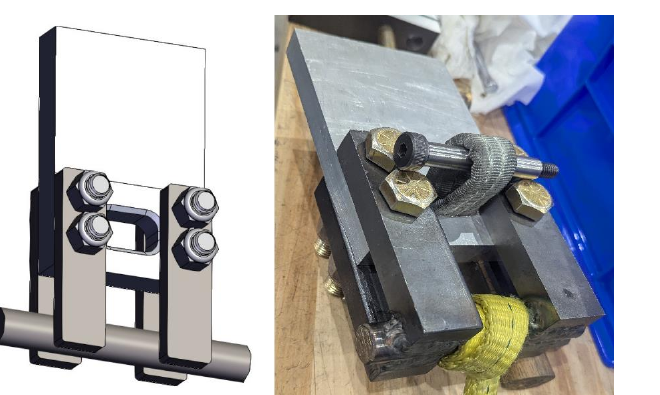
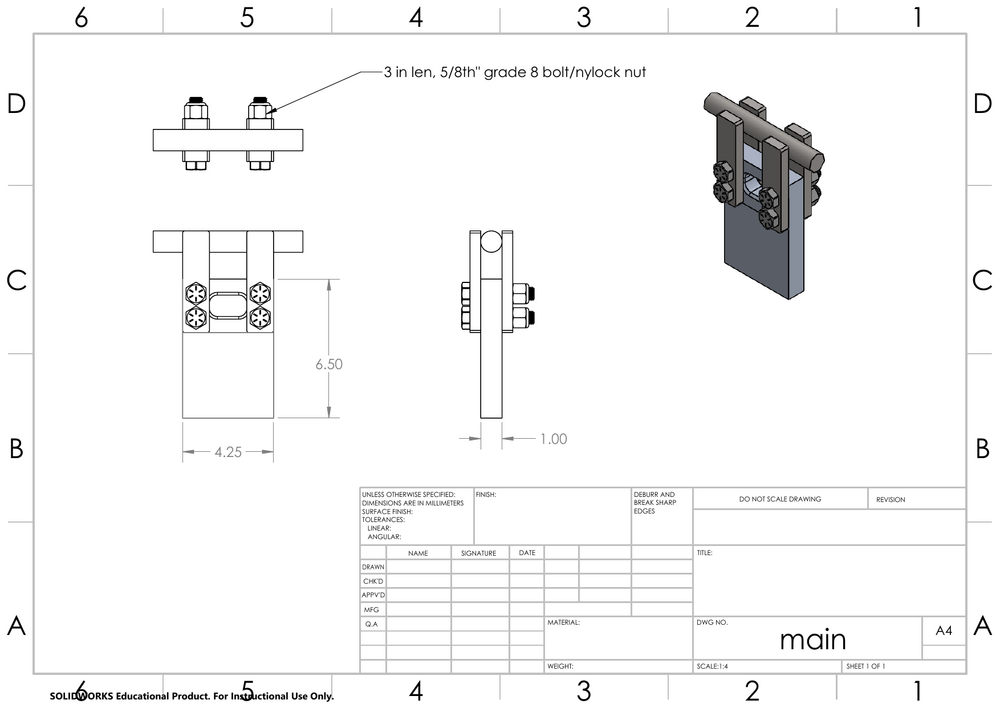
The strap wraps around a round bar, feeds through a hole and is pinned in place. Wrapping it around the bar means friction carries most of the load, which drastically reduces what the pin actually has to hold. From there the load transfers through the round bar into two large steel bars, then into bolts loaded in shear, and finally into an aluminum plate that the press grips.
Using two different materials there was deliberate. The press jaws are knurled, and the lower hardness of the aluminum lets them dig in and get a genuinely strong grip, which steel would not allow. The rest of the tooling is five steel parts, welded together and bolted onto the aluminum plate.
An FEA study of the steel bars at 2000 lbf per bolt hole showed a peak stress of 65.8 MPa, a factor of safety of 5.3 on the tooling itself. The bolts were nowhere near their limit. The design was intended to fail nowhere: the strap was supposed to be the only thing that broke.
Testing it
The test did not go exactly as designed. The strap we had was too long to fit in the press in single tension, so we pinned both ends and loaded it doubled up, in double tension, which halves the length and doubles the breaking load.
The first run ended early: the tooling slipped out of the jaws at 7634 lbf. That turned out not to be a grip failure at all. The wrapped strap tightens under load, and it tightened enough to momentarily drop the force to near zero, at which point the lower jaws simply loosened and fell away. The two large force drops visible in the data are that same tightening happening.
We reset and ran it again, and the second run went cleanly up until the strap failed at 10717 lbf. It broke where it was predicted to break, at the top where it makes a 180° turn around the round bar, with the tooling completely undamaged.
The result
Against the 4000 lbf double-tension rating, that gives an experimental factor of safety of 10717 / 4000 = 2.68, roughly half the manufacturer's claimed value of five. The tooling itself came through the test with nothing worse than jaw marks in the aluminum plate, which is exactly what that plate is there for, and it is still usable for breaking more and larger straps.
Factor of Safety Lab Report
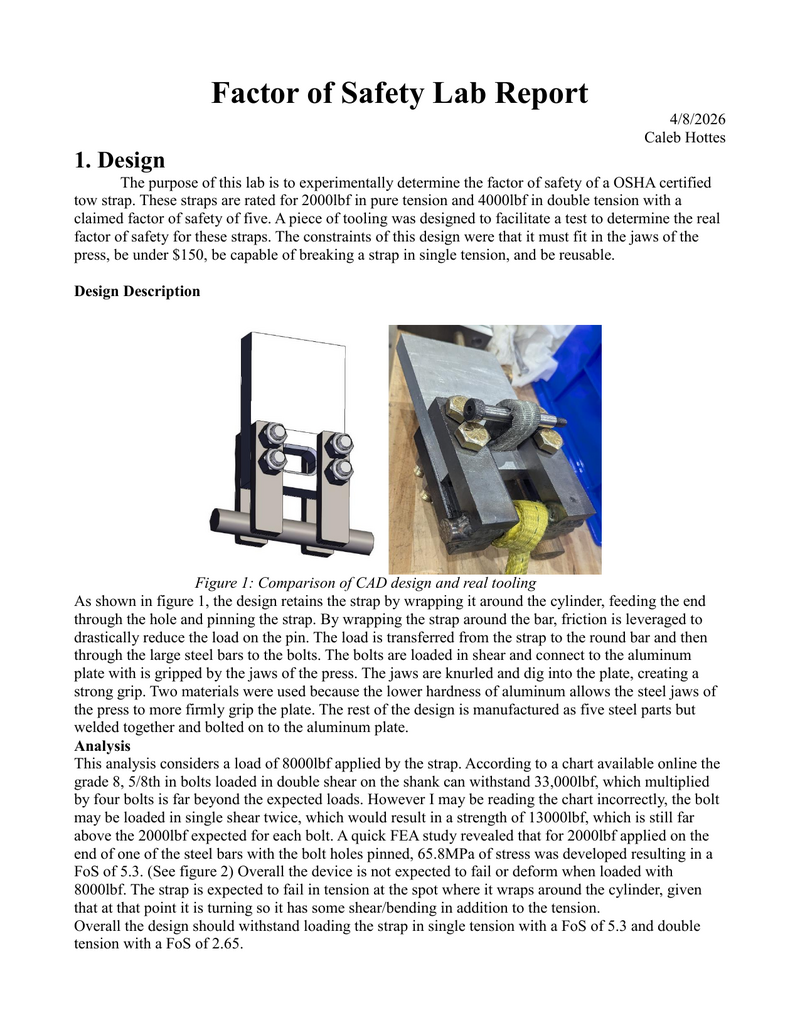
The full write-up: design rationale, the FEA study, both sets of test data, the failure description and the factor of safety calculation.
 Open Full Report